Foraminifera taxon details
Cantabriconus Schlagintweit, Rosales & Najarro, 2017 †
1067422 (urn:lsid:marinespecies.org:taxname:1067422)
accepted
Genus
Cantabriconus reocinianus Schlagintweit, Rosales & Najarro, 2017 † (type by original designation)
marine, brackish, fresh, terrestrial
fossil only
masculine
Schlagintweit, F.; Rosales, I.; Najarro, M. (2017). Cantabriconus reocinianus n. gen., n. sp. a new conical agglutinating benthic foraminifera from the upper Aptian-lower Albian of Cantabria, N-Spain. <em>Cretaceous Research.</em> 77: 93-101., available online at https://doi.org/10.1016/j.cretres.2017.05.010 [details] Available for editors  [request]
Original description Test a medium- to high-angled cone with slightly convex to almost flat base. The initial part is formed by a low trochoid...
Original description Test a medium- to high-angled cone with slightly convex to almost flat base. The initial part is formed by a low trochoid spire with eccentric embryo (“pfenderinid” sensu Hottinger and Drobne, 1980 or “arenobuliminid” sensu Boudagher-Fadel, 2008) of inflated chambers, enlarging rapidly in size and number arranged in up to 4 (?5) whorls. The spire is inclined to the longitudinal axis, and may be almost perpendicular to it. In the trochospiral growth stage, the position of the foramina is unclear. In assumed megalospheric specimens, the initial spire is rather voluminous. In the uniserial stage chambers are discoidal, more rarely slightly cup-shaped, and usually inflated marginally. Chamber lumen and septa are equal in thickness. In the central area, the chambers are perforated by numerous (cribrate) foramina, aligned vertically, surrounded by a non-perforated marginal zone without exoskeleton. The central part of the uniserial chambers contains an endoskeleton formed by rather thick pillars aligned vertically from one chamber to the next. The pillars may fuse to form micritic columella-like masses. These masses however do not form a continuous central solid part. Wall thick, agglutinated, most likely with a pseudo-keriothecal texture that is mostly obliterated by diagenetic processes. This texture has only been observed (in some specimens) as fine striation from the wall, not from the septa. [details]
Hayward, B.W.; Le Coze, F.; Vachard, D.; Gross, O. (2025). World Foraminifera Database. Cantabriconus Schlagintweit, Rosales & Najarro, 2017 †. Accessed at: https://www.marinespecies.org/foraminifera/aphia.php?p=taxdetails&id=1067422 on 2026-09-11
Date
action
by
original description
Schlagintweit, F.; Rosales, I.; Najarro, M. (2017). Cantabriconus reocinianus n. gen., n. sp. a new conical agglutinating benthic foraminifera from the upper Aptian-lower Albian of Cantabria, N-Spain. <em>Cretaceous Research.</em> 77: 93-101., available online at https://doi.org/10.1016/j.cretres.2017.05.010 [details] Available for editors [request]
[request]From editor or global species database
Original description Test a medium- to high-angled cone with slightly convex to almost flat base. The initial part is formed by a low trochoid spire with eccentric embryo (“pfenderinid” sensu Hottinger and Drobne, 1980 or “arenobuliminid” sensu Boudagher-Fadel, 2008) of inflated chambers, enlarging rapidly in size and number arranged in up to 4 (?5) whorls. The spire is inclined to the longitudinal axis, and may be almost perpendicular to it. In the trochospiral growth stage, the position of the foramina is unclear. In assumed megalospheric specimens, the initial spire is rather voluminous. In the uniserial stage chambers are discoidal, more rarely slightly cup-shaped, and usually inflated marginally. Chamber lumen and septa are equal in thickness. In the central area, the chambers are perforated by numerous (cribrate) foramina, aligned vertically, surrounded by a non-perforated marginal zone without exoskeleton. The central part of the uniserial chambers contains an endoskeleton formed by rather thick pillars aligned vertically from one chamber to the next. The pillars may fuse to form micritic columella-like masses. These masses however do not form a continuous central solid part. Wall thick, agglutinated, most likely with a pseudo-keriothecal texture that is mostly obliterated by diagenetic processes. This texture has only been observed (in some specimens) as fine striation from the wall, not from the septa. [details]

From editor or global species database
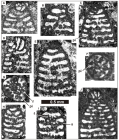
Image from typetaxon