Foraminifera taxon details
Spinobrunsiina Conil & Longerstaey, 1980 †
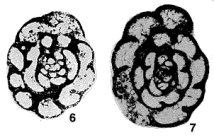
721655 (urn:lsid:marinespecies.org:taxname:721655)
accepted
Genus
Septabrunsiina (Spinobrunsiina) ramsbottomi Conil & Longerstaey, 1980 † accepted as Spinobrunsiina ramsbottomi (Conil & Longerstaey, 1980) † (type by original designation)
Septabrunsiina (Spinobrunsiina) Conil & Longerstaey, 1980 † · unaccepted (Opinion of Loeblich &Tappan...)
Opinion of Loeblich &Tappan (1987) nomen translatum
- Species Spinobrunsiina lidijae (Brazhnikova, 1971) †
- Species Spinobrunsiina morroensis (Mckay & Green, 1963) †
- Species Spinobrunsiina parakrainica (Skipp, Holcomb & Gutschik, 1966) †
- Species Spinobrunsiina pietoni (Conil & Lys, 1964) †
- Species Spinobrunsiina ramsbottomi (Conil & Longerstaey, 1980) †
- Species Spinobrunsiina subsymmetrica (Vdovenko, 1970) †
- Species Spinobrunsiina torquida (Zeller, 1957) †
- Species Spinobrunsiina anteflexa (Zeller, 1957) † accepted as Septabrunsiina anteflexa (Zeller, 1957) † (Opinion of Hance, Hou and Vachard (2011))
marine, brackish, fresh, terrestrial
fossil only
feminine
Conil, R.; Longerstaey, P. J.; Ramsbottom, W. H. C. (1980). Matériaux pour l'étude micropaléontologique du Dinantien de Grande-Bretagne. <em>Mémoires de l'Institut géologique de l'Université de Louvain.</em> 30[1979]: 5-186. [details] Available for editors  [request]
(of Septabrunsiina (Spinobrunsiina) Conil & Longerstaey, 1980 †) Conil, R.; Longerstaey, P. J.; Ramsbottom, W. H. C. (1980). Matériaux pour l'étude micropaléontologique du Dinantien de Grande-Bretagne. <em>Mémoires de l'Institut géologique de l'Université de Louvain.</em> 30[1979]: 5-186.
page(s): p. 54 [details] Available for editors [request]
[request] (of Septabrunsiina (Spinobrunsiina) Conil & Longerstaey, 1980 †) Conil, R.; Longerstaey, P. J.; Ramsbottom, W. H. C. (1980). Matériaux pour l'étude micropaléontologique du Dinantien de Grande-Bretagne. <em>Mémoires de l'Institut géologique de l'Université de Louvain.</em> 30[1979]: 5-186.
page(s): p. 54 [details] Available for editors
[request]
Hayward, B.W.; Le Coze, F.; Vachard, D.; Gross, O. (2024). World Foraminifera Database. Spinobrunsiina Conil & Longerstaey, 1980 †. Accessed at: https://www.marinespecies.org/foraminifera/aphia.php?p=taxdetails&id=721655 on 2024-04-16
Date
action
by
original description
Conil, R.; Longerstaey, P. J.; Ramsbottom, W. H. C. (1980). Matériaux pour l'étude micropaléontologique du Dinantien de Grande-Bretagne. <em>Mémoires de l'Institut géologique de l'Université de Louvain.</em> 30[1979]: 5-186. [details] Available for editors [request]
original description (of Septabrunsiina (Spinobrunsiina) Conil & Longerstaey, 1980 †) Conil, R.; Longerstaey, P. J.; Ramsbottom, W. H. C. (1980). Matériaux pour l'étude micropaléontologique du Dinantien de Grande-Bretagne. <em>Mémoires de l'Institut géologique de l'Université de Louvain.</em> 30[1979]: 5-186.
page(s): p. 54 [details] Available for editors [request]
basis of record Loeblich, A. R.; Tappan, H. (1987). Foraminiferal Genera and their Classification. Van Nostrand Reinhold Company, New York. 970pp., available online at https://books.google.pt/books?id=n_BqCQAAQBAJ [details] Available for editors [request]
[request] original description (of Septabrunsiina (Spinobrunsiina) Conil & Longerstaey, 1980 †) Conil, R.; Longerstaey, P. J.; Ramsbottom, W. H. C. (1980). Matériaux pour l'étude micropaléontologique du Dinantien de Grande-Bretagne. <em>Mémoires de l'Institut géologique de l'Université de Louvain.</em> 30[1979]: 5-186.
page(s): p. 54 [details] Available for editors
[request] basis of record Loeblich, A. R.; Tappan, H. (1987). Foraminiferal Genera and their Classification. Van Nostrand Reinhold Company, New York. 970pp., available online at https://books.google.pt/books?id=n_BqCQAAQBAJ [details] Available for editors
[request] From editor or global species database
Diagnosis Test enrolled, early stage streptospiral with pseudochambers, later becoming nearly planispiral with true septa and chambers; wall calcareous, microgranular, undifferentiated, supplementary deposits present in the form of nodes, arches, and basal projections and basal and lateral thickening; aperture simple. L. Carboniferous (Tournaisian to Visean); W. Europe; USSR; North America. (Loeblich & Tappan, 1987, Foraminiferal Genera and Their Classification) [details]