
Photo Gallery
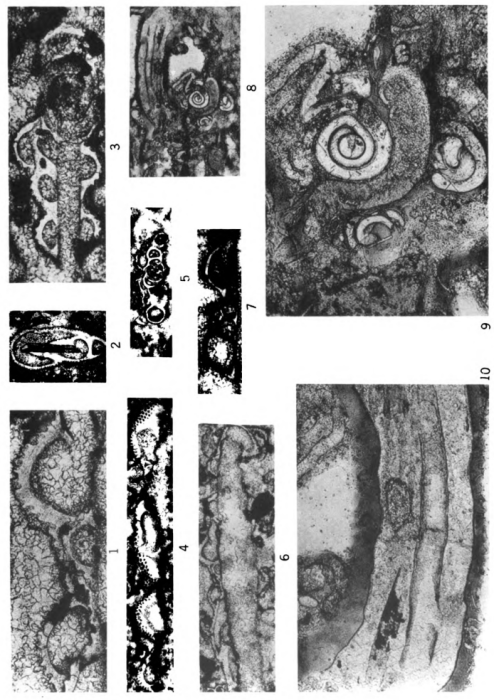
Hedraites plummerae Henbest, 1963
Description 1-10. Hedraites plummerae n . g., n. sp. Thin sections showing growth form, wall structure , and means of recognition in sectional views 1. Section, x 150, USGS collection f- 12218 (slide 18), (USNM 120580). Ibex Limestone of Cheney, Lower Permian, Shackelford County, Texas. 2. Specimen, x 40, attached to a spine or the axis of a plant (support not preserved). USGS collection f - 3729 (slide 5), (USNM 120581 ). Ibex Limestone of Cheney, Lower Permian, near Santa Anna, Texas. 3. Specimen, x 150, attached to axis or spine of unknown organism, USGS collection f-12218 (slide 41) (USNM 120582). 4. Specimen, x 40 , USGS collection f- 12219 ( slide 39) , (USNM 120583 ), encrusting a shell. Ibex Limestone of Cheney, Lower Permian, Shackelford County, Texas. 5. Cross section of specimen attached to an axis or spine, × 40, Ibex Limestone of Cheney, USGS collection f - 12219 (slide 38), (USNM 120584). 6. One or more individuals encrusting a shell, 40, same thin section as fig. 1. 7. Juvenarium, x 150, of either a microspheric individual H. plummerae or a related species. The form here is like those in Plate 2, figures 9 and 10. A slightly pitted surface is preserved on the innermost volution. USGS collection f - 12218 (slide 43) , (USNM 120585) . 8. Horizontal section through parts of several individuals, × 40, USGS collection f- 12763 ( slide 8) , (USNM 120586 ). Lower Permian, Archer County, Texas. 9-10. Parts of specimen in fig. 8, x 150, showing wall structure and canals of shell -perforating organisms Minytrypetes and Minylecytheca, which are illustrated in Plate 7, figures 1-4. General discussion of Plate 3. -The various appearances of the pitted surface of Hedraites as seen in thin section are displayed by all figures on this plate . The demonstration in figure 4,which is partly tangential , is unmistakable . The vertical sections of figures 1,4,and 6 and the horizontal sections of figures 8-10 show some tendency of the species for incrustation and massive growth form and illustrate characteristic attitudes on flat supports . Figures 2,3, and 5, illustrating specimens attached to axes of plants or animals , give striking examples of the protean growth form of Hedraites . The brownish , very finely granular structure of the porcellaneous walls of the Cornuspirinae is unusually well preserved in the thin sections in figures 8-10 , which is well core material . Nevertheless, the granularity seen here at 150 is probably coarser than originally existed . The shell material shows an obscure extinction pattern that is connected with calcite crystals in the matrix . The partial crystallization does not have a consistent relation to the shell form . These circumstances indicate a secondary origin for the incipient crystal structure . Figures 1 to 7 illustrate examples from the Ibex Limestone of Cheney in north central Texas , in which much of the original , structureless appearance of the porcellaneous wall is preserved , but the brownish color is generally missing . At magnifications no higher than 150 and in polarized light , the change from the porcellaneous structure to dark , finely granular , dolomitic (?) material that characterizes Ottonosia and Osagia is strikingly indicated (see discussion of Diagenesis and see also Plates 4 and 6). The decomposition and progress toward the dark replacement is particularly evident in figures 1,3,5,and 7. The exceptionally fine preservation of Hedraites in figures 8-10 affords a view of perforations of the shell of this foraminifer . The tubes ranging from 2 to 3 microns in diameter penetrate the walls at various and odd angles and positions . These are clearly the work of a parasitic , commensal , or saprophytic organism ( see plate 7,figures 1-4 ).
PNG file - 742.50 kB - 694 x 984 pixels
added on 2026-02-11104 viewsForaminifera taxa Hedraites plummerae Henbest, 1963 †checked Le Coze, François 2026-02-11

This work is licensed under a Creative Commons Attribution-NonCommercial-ShareAlike 4.0 International License
Click here to return to the thumbnails overview