Scleractinia taxon details
Phyllogyra Tomes, 1882 †
1438163 (urn:lsid:marinespecies.org:taxname:1438163)
accepted
Genus
Symphyllia etheridgei Duncan, 1872 † accepted as Phyllogyra etheridgei (Duncan, 1872) † (type by subsequent designation)
- Species Phyllogyra etheridgei (Duncan, 1872) †
- Species Phyllogyra sinuosa Tomes, 1882 † accepted as Paraphyllogyra sinuosa (Tomes, 1882) † (unaccepted > superseded combination, basionym)
marine, fresh, terrestrial
fossil only
Tomes RF. (1882). On the Madreporaria of the Inferior Oolite of the neighbourhood of Cheltenham and Gloucester. <em>Quarterly Journal of the Geological Society.</em> 38: 409-450, pl. 18., available online at http://jgslegacy.lyellcollection.org/cgi/doi/10.1144/GSL.JGS.1882.038.01-04.45 [details]
Description Massive meandroid corallum with short valleys. Septa of valleys not always present. No ambulacrum, just sometimes a small...
Description
Massive meandroid corallum with short valleys. Septa of valleys not always present. No ambulacrum, just sometimes a small...
Distribution
Western Europe; Middle Jurassic
South America; Middle Jurassic
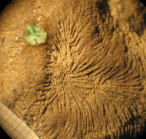
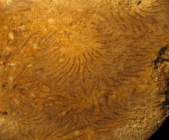
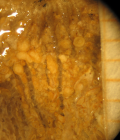
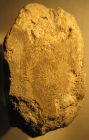
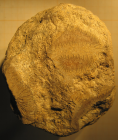
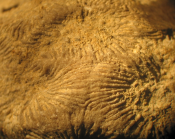
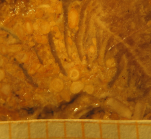
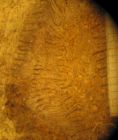
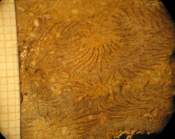
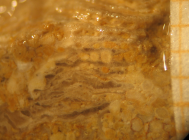
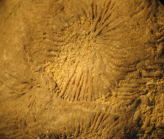
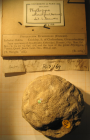
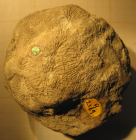
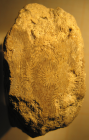
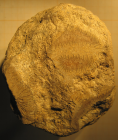
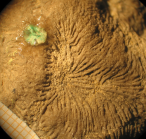
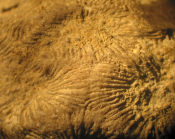
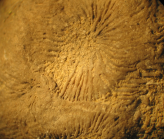
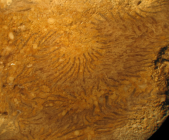
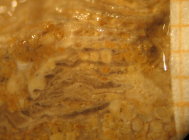
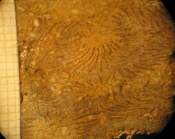
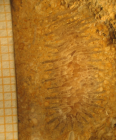
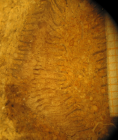
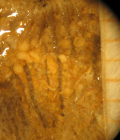
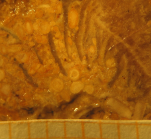
Description Massive meandroid corallum with short valleys. Septa of valleys not always present. No ambulacrum, just sometimes a small sulcus on the collines. Poorly elevated tholiform collines. No holotheca observed. Intracalicinal increase producing sinuous valleys with only one center in the width of the valley. New corallites occur also between valleys. Radial elements are compact free bicuneiform or attenuated, often curved, sometimes straight, confluent or not confluent on the collines. Distal edge with regular teeth (not well preserved on the lectotype); some trifid teeth typical for Montlivaltids observed at distal inner edge, lateral faces with acute granules or carinae(?), no pali. Montlivaltid microstructure. Hexameral symmetry cannot be deciphered, bilateral symmetry visible with curvature of septa. Endotheca made of dissepiments, columella absent, axial zone with a small fossa, synapticulae absent. Parathecal wall between valleys. [details]
Description
Massive meandroid corallum with short valleys. Septa of valleys not always present. No ambulacrum, just sometimes a small...
Description
Massive meandroid corallum with short valleys. Septa of valleys not always present. No ambulacrum, just sometimes a small sulcus on the collines. Poorly elevated tholiform collines. No holotheca observed. Intracalicinal increase producing sinuous valleys with only one center in the width of the valley. New corallites occur also between valleys. Radial elements are compact free bicuneiform or attenuated, often curved, sometimes straight, confluent or not confluent on the collines. Distal edge with regular teeth (not well preserved on the lectotype); some trifid teeth typical for Montlivaltids observed at distal inner edge, lateral faces with acute granules or carinae(?), no pali. Montlivaltid microstructure. Hexameral symmetry cannot be deciphered, bilateral symmetry visible with curvature of septa. Endotheca made of dissepiments, columella absent, axial zone with a small fossa, synapticulae absent. Parathecal wall between valleys. [details]
Massive meandroid corallum with short valleys. Septa of valleys not always present. No ambulacrum, just sometimes a small sulcus on the collines. Poorly elevated tholiform collines. No holotheca observed. Intracalicinal increase producing sinuous valleys with only one center in the width of the valley. New corallites occur also between valleys. Radial elements are compact free bicuneiform or attenuated, often curved, sometimes straight, confluent or not confluent on the collines. Distal edge with regular teeth (not well preserved on the lectotype); some trifid teeth typical for Montlivaltids observed at distal inner edge, lateral faces with acute granules or carinae(?), no pali. Montlivaltid microstructure. Hexameral symmetry cannot be deciphered, bilateral symmetry visible with curvature of septa. Endotheca made of dissepiments, columella absent, axial zone with a small fossa, synapticulae absent. Parathecal wall between valleys. [details]
Distribution
Western Europe; Middle Jurassic
South America; Middle Jurassic
Distribution
Western Europe; Middle Jurassic
South America; Middle Jurassic [details]
Western Europe; Middle Jurassic
South America; Middle Jurassic [details]
Hoeksema, B. W.; Cairns, S. (2025). World List of Scleractinia. Phyllogyra Tomes, 1882 †. Accessed at: https://www.marinespecies.org/scleractinia/aphia.php?p=taxdetails&id=1438163 on 2026-09-21
Date
action
by
original description
Tomes RF. (1882). On the Madreporaria of the Inferior Oolite of the neighbourhood of Cheltenham and Gloucester. <em>Quarterly Journal of the Geological Society.</em> 38: 409-450, pl. 18., available online at http://jgslegacy.lyellcollection.org/cgi/doi/10.1144/GSL.JGS.1882.038.01-04.45 [details]
basis of record Cairns, S.D., R. Baron-Szabo, A.F. Budd, B. Lathuilière, E. Roniewicz, J. Stolarski & K.G. Johnson. (2010). Corallosphere. , available online at http://www.corallosphere.org [details]
additional source Beauvais L. (1970). Sur quelques genres nouveaux ou peu connus de Madréporaires jurassiques. <em>Eclogae geologicae Helvetiae.</em> 63 (3): 1109-1131, pls. 1-4. [details]
additional source Duncan PM (1884) A revision of the families and genera of the sclerodermic Zoantharia, Ed. & H., or Madreporaria (M. Rugosa excepted). Journal of the Linnean Society of London, 18: 1-204. [details]
additional source Wells JW. (1936). The nomenclature and type species of some genera of recent and fossil corals. <em>American Journal of Science.</em> 31: 97-134., available online at https://ajsonline.org/article/61464 [details]
 Present Inaccurate Introduced: alien Containing type locality
From editor or global species database
Comparison The genus is very close of Complexastrea but meandroid. [details]Description Massive meandroid corallum with short valleys. Septa of valleys not always present. No ambulacrum, just sometimes a small sulcus on the collines. Poorly elevated tholiform collines. No holotheca observed. Intracalicinal increase producing sinuous valleys with only one center in the width of the valley. New corallites occur also between valleys. Radial elements are compact free bicuneiform or attenuated, often curved, sometimes straight, confluent or not confluent on the collines. Distal edge with regular teeth (not well preserved on the lectotype); some trifid teeth typical for Montlivaltids observed at distal inner edge, lateral faces with acute granules or carinae(?), no pali. Montlivaltid microstructure. Hexameral symmetry cannot be deciphered, bilateral symmetry visible with curvature of septa. Endotheca made of dissepiments, columella absent, axial zone with a small fossa, synapticulae absent. Parathecal wall between valleys. [details]
Description
Massive meandroid corallum with short valleys. Septa of valleys not always present. No ambulacrum, just sometimes a small sulcus on the collines. Poorly elevated tholiform collines. No holotheca observed. Intracalicinal increase producing sinuous valleys with only one center in the width of the valley. New corallites occur also between valleys. Radial elements are compact free bicuneiform or attenuated, often curved, sometimes straight, confluent or not confluent on the collines. Distal edge with regular teeth (not well preserved on the lectotype); some trifid teeth typical for Montlivaltids observed at distal inner edge, lateral faces with acute granules or carinae(?), no pali. Montlivaltid microstructure. Hexameral symmetry cannot be deciphered, bilateral symmetry visible with curvature of septa. Endotheca made of dissepiments, columella absent, axial zone with a small fossa, synapticulae absent. Parathecal wall between valleys. [details]
Distribution
Western Europe; Middle Jurassic
South America; Middle Jurassic [details]
Morphology The genus is very close of Complexastrea but meandroid. [details]
Type designation Subsequent designation by Wells (1936) [details]

From editor or global species database