Current number of accepted fossil species: 40,966
Current number of total accepted (fossil + recent) species: 49,050
Current number of accepted fossil subspecies: 4,457
Current number of total accepted (fossil + recent) subspecies: 5,063
The World Foraminifera Database
This World Database of all species of Foraminifera ever described (recent and fossil), is part of the World Register of Marine Species (WoRMS), a global initiative to provide a register of all marine organisms.
Searching the database (fossil and/or recent)
The default setting is to search the whole database of fossil and recent species. If you would like to only search the recent (living) taxa then tick the 'extant' box in the Taxon Search window.
What are Foraminifera?
Foraminifera (‘hole bearers’), foraminifers or forams for short, are a large phylum of amoeboid protozoans (single celled) with reticulating pseudopods, fine strands of cytoplasm that branch and merge to form a dynamic net. They usually produce a test (or shell) which can have one or more chambers, and are made of calcium carbonate (CaCO3) or mineral grains or other particles glued together. The tests are usually less than 0.5 mm in size, but the largest can be up to 20 cm across. Foraminifera are among the most abundant and scientifically important groups of organisms. The tests of recently dead planktic foraminifera are so abundant that they form a thick blanket over one third of the surface of the Earth (as Globigerina ooze on the ocean floor). Foraminifera are essentially marine and estuarine-dwelling protozoans living in all environments from the greatest depths right up to highest astronomical tide level and from the equator to the poles.
The importance of foraminifera comes from the use of their fossil tests in biostratigraphy, paleoenvironment studies, and isotope geochemistry. Their ubiquity in most marine sedimentary rocks, often as large, well-preserved, diverse assemblages, has resulted in their being the most studied group of fossils worldwide. Because recent foraminifera have attracted little interest from biologists, paleontologists have been forced to undertake most studies, including genetic research, on the living fauna.
This site has the following aims:
- to provide a catalogue of the world's foraminiferal species
- to promote stability in foraminiferal nomenclature
- to act as a tool for higher taxonomic revisions and regional monographs
Higher classification
The list of currently accepted species-group names is at least 90% complete for recent species, but the taxonomy of many taxa still needs revision and newly described species will be added as soon as possible after publication, a task that will be undertaken continuously by the editors. Fossil genera and higher taxa are mostly complete but fossil species will take many years to add in. There is currently no broad consensus available for the higher classification of the Foraminifera. Here, the classification given in Loeblich and Tappan (1987 and 1992) is mostly used for calcareous taxa and Kaminski (2004) is followed for agglutinated taxa, but the higher level classification of Foraminifera is in a state of revision and has been updated to comply with the genetic sequence-based results to date of Pawlowski et al. (2013) and Holzmann and Pawlowski (2017). Further results of ongoing molecular phylogenetic investigations will hopefully help to stabilise the taxonomic system in the future.
The higher classification of the extinct Class Fusulinata has been extensively reviewed under the supervision of Daniel Vachard, providing a classification down to the families recently updated in Vachard (2016a, b), Vachard and Le Coze (2022) and completing, at genus level, the classification inherited from Loeblich & Tappan (1987), Vdovenko et al. (1993), and Rauzer-Chernousova et al. (1996)."
- Holzmann, M. and Pawlowski, J. (2017). An updated classification of rotaliid foraminifera based on ribosomal DNA phylogeny. Marine Micropaleontology 132, 18-34.
- Kaminski, M. A. (2004). The Year 2000 Classification of the Agglutinated Foraminifera. In: M. K. Bubik, Ma. (ed). Proceedings of the Sixth International Workshop on Agglutinated Foraminifera. Grzybowski Foundation Special Publication. Pp. 237-255.
- Loeblich, A. R., and Tappan, H. (1987). "Foraminiferal genera and their classification." Van Nostrand Reinhold, New York.
- Loeblich, A. R., and Tappan, H. (1992). Present status of foraminiferal classification. In "Studies in Benthic foraminifera. Proceedings of the Fourth Symposium on benthic foraminifera, Sendai, 1990." (Y. Takayanagi, and T. Saito, Eds.), pp. 93-102. Tokai University Press, Tokyo.
- Pawlowski, J., Holzmann, M., Tyszka, J. (2013). New supraordinal classification of Foraminifera: Molecules meet morphology. Marine Micropaleontology 100, 1-10
Steering Committee
A steering committee provides international oversight and fosters the compilation and rationalisation of the World Foraminifera Database.
The steering committee members are:
- Tomas Cedhagen, Denmark
- Peter Frenzel, Germany
- Bruce W. Hayward, New Zealand (convenor)
- Martin Langer, Germany
- François Le Coze, France
- Willem Renema, The Netherlands
- Johannes Pignatti, Italy
- Lorenzo Consorti, Italy
- Felix Schlagintweit, Germany
Editors
Enter data and make taxonomic decisions in the groups they have responsibility for:
- Hayward, Bruce: Foraminifera
- Cedhagen, Tomas: Allogromiida, Astrorhizida, Gromiida
- Consorti, Lorenzo: Foraminifera
- D'Onofrio, Roberta: Foraminifera
- Le Coze, François: Foraminifera
- Pignatti, Johannes: Foraminifera
- Trevisan Disaró, Sibelle: Foraminifera
Editors are responsible for entries, decision on validity of names. Corrections and omissions may be addressed to either editor.
Acceptance of a species in the database is an editorial decision, but we acknowledge such decisions need to be re-examined frequently in the light of new information. If you disagree with senior synonymy decisions or genus assignments, please let us have your well-argued-corrected assignment. Only the editors can add or modify the data, but anybody can upload images with identifications and location information, although this will be checked and can be modified by the editors
History of the World Foraminifera Database
The World Foraminifera Database began as the European recent species list compiled by Tomas Cedhagen and Onno Gross. Added to this in 2010 were the Gulf of Mexico recent species list compiled by Barun Sen Gupta and colleagues and the New Zealand modern species list compiled by Bruce Hayward and colleagues.
- Gross, O. (2001). Foraminifera, in: Costello, M.J. et al. (Ed.) (2001). European register of marine species: a check-list of the marine species in Europe and a bibliography of guides to their identification. Collection Patrimoines Naturels, 50: 60-75.
- Hayward, B.W., Tendal, O.S., Carter, R., Grenfell, H.R., Morgans, H.E.G., Scott, G.H., Strong, C.P., Hayward, J.J. (2012). Phylum Foraminifera. Foraminifera and Xenophyophores. In: Gordon, D.P. (ed.). New Zealand Inventory of biodiversity: A Species 2000 Symposium Review. Canterbury University Press,. Christchurch. Pp. 242-287
- Sen Gupta, B.K., Smith, L.E., Machain-Castillo, M.L. (2009). Foraminifera of the Gulf of Mexico, Pp. 87–129 in Felder, D.L. and D.K. Camp (eds.), Gulf of Mexico–Origins, Waters, and Biota. Biodiversity. Texas A&M Press, College Station, Texas.
Since then records have been added from Johannes Pignatti’s catalogue of recent foraminifera, many major atlases of Recent foraminifera and output from Ellis and Messina Catalogue of Foraminifera.
For information about the recent devlopment of the database please consult Hayward et al. (2020) (Hayward, B.W., Le Coze, F., Vanderpitte, L., Vanhoorne, B., 2020. Foraminifera in the World Register of Foraminifera (WoRMS) taxonomic database. Journal of Foraminiferal Research 50: 291-300.)
Who described the largest number of recent Foraminiferal species?
- McCulloch – 2429
- Cushman – 1134
- D’Orbigny – 691
- Brady – 398
- Saidova – 394
- Earland - 306
Literature Library
The literature library currently contains ~19,000 references, many of the older works are available as scanned PDFs.
Photogallery
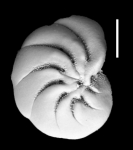
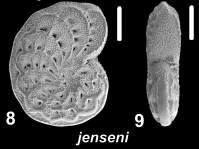
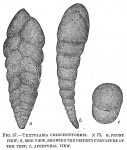
The Photogallery currently contains ~6000 images linked to species records, mostly entered by Tomas Cedhagen from Brady’s Challenger volume and Cushman monographs, but also some other monographs.
Tasks to be done
The steering committee has identified the following tasks that could be undertaken to improve the usefulness and value of the Forams in WoRMS database. The tasks have been assigned to one of three perceived priority lists. We invite any worker who wants to make this database more useful by contributing to any of the tasks below on a voluntary basis, to contact the chair of the Steering Committee, Bruce Hayward by email.
1. First priority- Achieve 100% entry of all foraminiferal taxonomic names formally proposed. [current estimate about 95%].
- Add all new taxa as they are proposed. [current practice]
- Update higher taxonomy as it is revised based on molecular evidence. [current practice]
- Update taxonomy and synonymies of taxa as new molecular and comprehensive morphological studies are published. [current practice]
- Achieve 100% coverage for images of types or verified specimens of all accepted extant taxa [either loaded directly in WoRMS database or through links to institutional databases]
- Check all pre 2010 entries to ensure they no longer contain errors.
- Negotiate links to reputable images/taxonomic descriptions available on institutional (long-lived) web sites. [difficult to achieve as most institutions do not rate this highly and do not have resources to provide us with file names linked to taxa]
- Achieve 100% coverage for images of types or verified specimens of all accepted fossil taxa [either loaded directly in WoRMS database or through links to institutional databases]
- Assign all fossil taxa to at least one or more of the following time periods: Paleozoic, Triassic, Jurassic, Cretaceous, Paleogene, Neogene.
- Provide a link on the web or load on WoRMS a copy of all publications that describe new foraminifera taxa.
- Use the Forams in WoRMS literature sources database (currently 11,000 entries) as the starting point to develop a comprehensive bibliography of world foraminifera publications.
- Give known time ranges (more precise than periods) to all fossil taxa.
- Achieve global geographic distribution data for all extant species.
- Achieve global geographic distribution coverage for all fossil species.
Links to other Foraminiferal sites
To assist the beginner or the non-specialist we provide here a selection of links to foraminiferal websites for further information.
- Illustrated glossary of terms used in foraminiferal research http://paleopolis.rediris.es/cg/CG2006_M02/index.html
- Techniques for preparing samples for study of foraminifera in the classroom http://www.ucmp.berkeley.edu/fosrec/Snyder&Huber.html
- Foram Facts http://www.ucmp.berkeley.edu/fosrec/Wetmore.html
- Wikipedia http://en.wikipedia.org/wiki/Foraminifera
- Foraminiferal references http://www.es.ucl.ac.uk/Grzybowski/foramrefs.htm
- Cushman Foundation for Foraminiferal Research http://www.cushmanfoundation.org/
- Grzybowski Foundation http://www.es.ucl.ac.uk/Grzybowski/
- The Micropalaeontological Society http://www.tmsoc.org/
- University of California Museum of Paleontology – Introduction to foraminifera http://www.ucmp.berkeley.edu/foram/foramintro.html
- University College, London – Foraminifera http://www.ucl.ac.uk/GeolSci/micropal/foram.html
- The Foraminifera.eu Project http://www.foraminifera.eu/
- E-formas http://www.eforams.org
- Molecular Database of Foraminifera http://forambarcoding.unige.ch/
- Biography of Joseph Cushman https://naturalhistory.si.edu/research/paleobiology/collections-overview/foraminifera-collections/joseph-cushman
- Planktic foraminiferal taxonomy https://www.mikrotax.org/pforams/index.html
Citation
Usage of data from the World Foraminifera Database in scientific publications should be acknowledged by citing as follows:- Hayward, B.W.; Le Coze, F.; Vachard, D.; Gross, O. (2026). World Foraminifera Database. Accessed at https://www.marinespecies.org/foraminifera on 2026-05-06. doi:10.14284/305
Individual pages are individually authored and dated. These can be cited separately: the proper citation is provided at the bottom of each page.
About
The World List is a searchable catalogue of species and higher taxa names.
Navigating this catalogue starts with clicking on one of the choices in the menu, which you find on the top of each page
- Introduction will lead you this introductory section
- Search taxa will lead to a query page through which all taxon pages can be accessed
- Browse taxa will lead to a taxonomic tree
- Checklist will lead to a query page in which a geounit can directly be picked if the exact name of the unit is already known. This way a list of taxa for a given area can be found quickly.
- Attributes will lead to a page to query (mainly) fossil ranges
- Stats some statistics about the World Foraminifera Database
- Sources will lead to a query page for References of Foraminifera literature.
- Images will lead to photogallery with images
- Login only available to editors.
For each foraminiferal species or infraspecific taxon, accepted or not, there may be the following entries:
- genus name
- the subgenus name, if applicable,
N.B. subgenus names do not need to be cited at all times according to the ICZN; acceptance of combinations without subgenus names is considered ‘alternative representation’ in the database. - the species name
- the infraspecific name, if applicable
- the author and year of the species name, without or with brackets depending on whether it is the original combination or not
- The AphiaID (a unique numerical database identifier)
- The higher classification (according to Loeblich and Tappan, 1990, 1992)
- The status as ‘accepted’ or ‘unaccepted’ (if applicable; junior synonymy is usually based on published revision)
- Record status (indicates who checked the record)
- Rank of taxon, e.g. species
- Parent: immediately higher taxon, e.g. genus, to which the present taxon belongs
- Synonymized taxa: the list of junior synonyms linked to the present name
- Sources: literature reference of the original description and if applicable to a recent revision (as the ‘basis of the record’).
- Child taxa: all immediate subordinate taxa, e.g. subspecies
- Environment: marine or brackish
- Fossil range: recent only or also known as fossil (soon epoch ranges will be available)
- Distribution: indication of the recent geographic distribution of the taxon, at least based on the origin of
the holotype,
Different geounits may be indicated, preferably the Marine Ecoregion (see Spalding et al. 2007), but frequently also the country’s Exclusive Economic Zone. The distribution areas of the junior synonyms are automatically shown with each ‘accepted species’ - Specimen: type specimen information, or published specimen information
- Links: to other foraminiferal resources, to images and other information on specific servers. Current general links are: Genbank, etc.
- Notes: any further relevant information, including descriptions, comments, explanations, etc.
-
Images: photos or other images uploaded to the site
We prefer ‘objective’ images of the taxa, such as photos or illustrations of type specimens. We do not encourage photos of unidentified foraminifera, but reliably identified copyright free images are welcome. - LSID notation: (similar to ISBN in publications)
- Edit history: date of entry and changes made, name of editor
- Links to a Taxonomic tree, Google, Google Scholar and Google images.
The records on higher taxa generally have the same structure as those of the species records. Not all of the above items already exist for all taxa entered in the database, but they will be added as time permits.
What you can do with this database at this time is find out what the currently accepted combination is of your subject foraminifer, what its currently accepted higher taxon affiliation is, and from where it was originally described. You can also check which accepted species occur in a higher taxon. What you cannot (yet) do is find every published combination of genus and species name, as we have given priority so far to the original and the currently accepted combinations (so non-original non-accepted combinations are frequently still lacking). What you also cannot do comprehensively is trace the distributions of species and higher taxa or extract regional lists of species, because there is as yet no consistency in the data entered from around the world.