Foraminifera taxon details
Pseudovermiporella Elliott, 1958 †
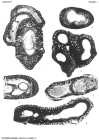
1052857 (urn:lsid:marinespecies.org:taxname:1052857)
accepted
Genus
Pseudovermiporella sodalica Elliott, 1958 † (type by original designation)
- Species Pseudovermiporella elliotti Erk & Bilgütay, 1960 †
- Species Pseudovermiporella longipora (Praturlon, 1963) †
- Species Pseudovermiporella nipponica (Endo in Endo & Kanuma, 1954) †
- Species Pseudovermiporella sodalica Elliott, 1958 †
- Species Pseudovermiporella graiferi (Baryshnikov, 1982) † accepted as Palaeonubecularia graiferi (Baryshnikov, 1982) † (unaccepted > superseded combination, Opinion of Vachard in Granier et al. (2022))
marine, brackish, fresh, terrestrial
fossil only
feminine
Elliott, G. F. (1958). Fossil Microproblematica from the Middle East. <em>Micropaleontology.</em> 4(4): 419-428., available online at https://doi.org/10.2307/1484269
page(s): p. 419 [details] Available for editors
[request]
page(s): p. 419 [details] Available for editors
Description Diagnosis: Test attached. Proloculus spherical to reniform and juvenarium glomospiroid, both rarely preserved. Adult stage,...
Description Diagnosis: Test attached. Proloculus spherical to reniform and juvenarium glomospiroid, both rarely preserved. Adult stage, most commonly preserved under the form of cylindrical, undivided chamber with thick wall, perforated by pits, perpendicular to oblique of the periphery, shallow or deep; perhaps without communications with the cytoplasm of the chambers. Wall porcelaneous generally dark; rarely well-preserved with amber-color, commonly also neomicrosparitized and withish, and giving in this case the “vermiporellacean” aspect. Aperture at the extremity of the tubular chamber.
Occurrence: Late early Permian (Artinskian)–latest Permian (late Changhsingian; Zhao et al., 1981; Flügel & Reinhardt, 1989; Vachard et al., 2003), cosmopolitan. Common in Lopingian of southern Turkey (Hazro) and Zagros. In our opinion, the FO in the Carnic Alps in the uppermost Grenzland Formation corresponds possibly to the FAD (oldest appearance) of the undisputable Pseudovermiporella (see also Lucas et al., 2015 and Vachard et al., 2015).
(Vachard in Krainer et al. (2019)). [details]
Occurrence: Late early Permian (Artinskian)–latest Permian (late Changhsingian; Zhao et al., 1981; Flügel & Reinhardt, 1989; Vachard et al., 2003), cosmopolitan. Common in Lopingian of southern Turkey (Hazro) and Zagros. In our opinion, the FO in the Carnic Alps in the uppermost Grenzland Formation corresponds possibly to the FAD (oldest appearance) of the undisputable Pseudovermiporella (see also Lucas et al., 2015 and Vachard et al., 2015).
(Vachard in Krainer et al. (2019)). [details]
Hayward, B.W.; Le Coze, F.; Vachard, D.; Gross, O. (2025). World Foraminifera Database. Pseudovermiporella Elliott, 1958 †. Accessed at: https://www.marinespecies.org/foraminifera/aphia.php?p=taxdetails&id=1052857 on 2026-05-14
Date
action
by
original description
Elliott, G. F. (1958). Fossil Microproblematica from the Middle East. <em>Micropaleontology.</em> 4(4): 419-428., available online at https://doi.org/10.2307/1484269
page(s): p. 419 [details] Available for editors
[request]
page(s): p. 419 [details] Available for editors
From editor or global species database
Description Diagnosis: Test attached. Proloculus spherical to reniform and juvenarium glomospiroid, both rarely preserved. Adult stage, most commonly preserved under the form of cylindrical, undivided chamber with thick wall, perforated by pits, perpendicular to oblique of the periphery, shallow or deep; perhaps without communications with the cytoplasm of the chambers. Wall porcelaneous generally dark; rarely well-preserved with amber-color, commonly also neomicrosparitized and withish, and giving in this case the “vermiporellacean” aspect. Aperture at the extremity of the tubular chamber.Occurrence: Late early Permian (Artinskian)–latest Permian (late Changhsingian; Zhao et al., 1981; Flügel & Reinhardt, 1989; Vachard et al., 2003), cosmopolitan. Common in Lopingian of southern Turkey (Hazro) and Zagros. In our opinion, the FO in the Carnic Alps in the uppermost Grenzland Formation corresponds possibly to the FAD (oldest appearance) of the undisputable Pseudovermiporella (see also Lucas et al., 2015 and Vachard et al., 2015).
(Vachard in Krainer et al. (2019)). [details]