Foraminifera taxon details

Milleporidae Fleming, 1828
196235  (urn:lsid:marinespecies.org:taxname:196235)

accepted
Family

Ordering

  • Alphabetically
  • By status

Children Display

marine, brackish, fresh, terrestrial
recent + fossil
(of ) Fleming, J. (1828). A history of British animals, exhibiting the descriptive characters and systematical arrangement of the genera and species of quadrupeds, birds, reptiles, fishes, Mollusca, and Radiata of the United Kingdom; including the indigenous, extirpated, and extinct kinds, together with periodical and occasional visitants. <em>Edinburgh, Bell & Bradfute / London, James Duncan.</em> Pp. i-xxii, 1-565. corrigenda., available online at http://www.biodiversitylibrary.org/item/18569
page(s): 528 [details] 
Diagnosis Hydroid colony forming massive, calcareous exoskeletons (= coenosteum) of varied shape; coenosteum with an internal complex...  
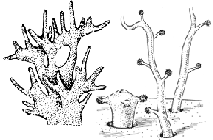
Diagnosis Hydroid colony forming massive, calcareous exoskeletons (= coenosteum) of varied shape; coenosteum with an internal complex network of coenosarcal tubes and covered externally by a thin ectodermal layer, coenosteal surface perforated by pores; margins of pores not elevated; large gastropores surrounded by smaller dactylopores, forming indistinct cyclosystems; polyps polymorphic; gastrozooids relatively short and stout, with an oral whorl of four to seven short capitate tentacles, arising from gastropores; dactylozooids long, slender, mouthless, with scattered capitate tentacles, arising from dactylopores; cnidome with stenoteles and macrobasic mastigophores; gonophores arising from coenosarc within chambers embedded entirely in the coenosteum.
Medusa free swimming eumedusoids with exumbrellar nematocyst patches, radial and circular canals present, without tentacles and sense organs; gonads occupying the place of an indistinct manubrium. [details]
Foraminifera (2025). Milleporidae Fleming, 1828. Accessed at: https://www.marinespecies.org/foraminifera/aphia.php?p=taxdetails&id=196235 on 2025-10-27
Date
action
by
2005-12-30 14:07:12Z
created
2009-04-28 06:22:10Z
changed
2024-10-22 16:52:51Z
changed

original description (of ) Fleming, J. (1828). A history of British animals, exhibiting the descriptive characters and systematical arrangement of the genera and species of quadrupeds, birds, reptiles, fishes, Mollusca, and Radiata of the United Kingdom; including the indigenous, extirpated, and extinct kinds, together with periodical and occasional visitants. <em>Edinburgh, Bell & Bradfute / London, James Duncan.</em> Pp. i-xxii, 1-565. corrigenda., available online at http://www.biodiversitylibrary.org/item/18569
page(s): 528 [details] 

context source (MSBIAS) MEDIN. (2011). UK checklist of marine species derived from the applications Marine Recorder and UNICORN. version 1.0. [details] 
 
 Present  Inaccurate  Introduced: alien  Containing type locality 
From editor or global species database
Diagnosis Hydroid colony forming massive, calcareous exoskeletons (= coenosteum) of varied shape; coenosteum with an internal complex network of coenosarcal tubes and covered externally by a thin ectodermal layer, coenosteal surface perforated by pores; margins of pores not elevated; large gastropores surrounded by smaller dactylopores, forming indistinct cyclosystems; polyps polymorphic; gastrozooids relatively short and stout, with an oral whorl of four to seven short capitate tentacles, arising from gastropores; dactylozooids long, slender, mouthless, with scattered capitate tentacles, arising from dactylopores; cnidome with stenoteles and macrobasic mastigophores; gonophores arising from coenosarc within chambers embedded entirely in the coenosteum.
Medusa free swimming eumedusoids with exumbrellar nematocyst patches, radial and circular canals present, without tentacles and sense organs; gonads occupying the place of an indistinct manubrium. [details]
    Definitions

Loading...


LanguageName 
Japanese アナサンゴモドキ科  [details]