Foraminifera taxon details
Pseudedomia Henson, 1948 †
722012 (urn:lsid:marinespecies.org:taxname:722012)
accepted
Genus
Pseudedomia multistriata Henson, 1948 † (type by original designation)
Praecosinella Emberger et al., 1955 † · unaccepted (Name unavailable according to...)
Name unavailable according to ICZN Arts 13 (a)(i) no description
- Species Pseudedomia complanata Eames & Smout, 1955 †
- Species Pseudedomia hamaouii Rahaghi, 1976 †
- Species Pseudedomia hekimhanensis Görmüş, 1999 †
- Species Pseudedomia multistriata Henson, 1948 †
- Species Pseudedomia persica Rahaghi, 1989 †
- Species Pseudedomia drorimensis Reiss, Hamaoui & Ecker, 1964 † accepted as Sellialveolina drorimensis (Reiss, Hamaoui & Ecker, 1964) † (Opinion of Vicedo et al. (2011))
- Species Pseudedomia globularis Smout, 1963 † accepted as Pseudochubbina globularis (Smout, 1963) † (Type species of Pseudochubbina)
- Species Pseudedomia viallii (Colalongo, 1963) † accepted as Sellialveolina viallii Colalongo, 1963 † (unaccepted > superseded combination)
marine, brackish, fresh, terrestrial
fossil only
feminine
Henson, F. R. S. (1948). Larger imperforate foraminifera of south-western Asia. Families Lituolidae, Orbitolinidae and Meandropsinidae. <em>British Museum (Natural History).</em> 1-127.
page(s): p. 95 [details] Available for editors [request]
page(s): p. 95 [details] Available for editors
[request]
Hayward, B.W.; Le Coze, F.; Vachard, D.; Gross, O. (2024). World Foraminifera Database. Pseudedomia Henson, 1948 †. Accessed at: https://www.marinespecies.org/foraminifera/aphia.php?p=taxdetails&id=722012 on 2024-09-16
Date
action
by
original description
Henson, F. R. S. (1948). Larger imperforate foraminifera of south-western Asia. Families Lituolidae, Orbitolinidae and Meandropsinidae. <em>British Museum (Natural History).</em> 1-127.
page(s): p. 95 [details] Available for editors [request]
basis of record Loeblich, A. R.; Tappan, H. (1987). Foraminiferal Genera and their Classification. Van Nostrand Reinhold Company, New York. 970pp., available online at https://books.google.pt/books?id=n_BqCQAAQBAJ [details] Available for editors [request]
page(s): p. 95 [details] Available for editors
[request] basis of record Loeblich, A. R.; Tappan, H. (1987). Foraminiferal Genera and their Classification. Van Nostrand Reinhold Company, New York. 970pp., available online at https://books.google.pt/books?id=n_BqCQAAQBAJ [details] Available for editors
[request] From editor or global species database
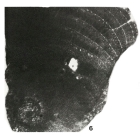
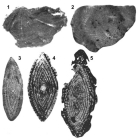
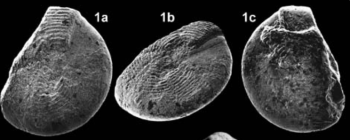
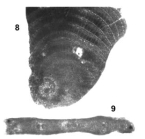
Diagnosis Microspheric test globular to lenticular in the early stage, discoidal in the adult and up to 3.5 mm in diameter, early stage of about six planispiral and involute whorls, the last with over twenty chambers, chambers becoming progressively longer and strongly overlapping the preceding chambers until they become cyclical, chamber interior with central filling in the lower part, leaving open a narrow preseptal space occupied by pillars, increasing from a single pillar in the earliest chambers to many pillars confined to the equatorial plane, secondary partitions parallel to and perpendicular to the septa form small chamberlets; megalospheric test lenticular, up to 2.3 mm in diameter, proloculus followed by flexostyle and then by about seven whorls of up to seven chambers each; wall calcareous, imperforate, porceianeous; aperture consists of numerous pores in the final chamber face, corresponding in position to the chamberlets. U. Cretaceous (Cenomanian to Maastrichtian); Qatar; Kuwait; Tunisia; Lebanon; Iraq; Israel; Italy; Portugal; Yugoslavia; Greece. (Loeblich & Tappan, 1987, Foraminiferal Genera and Their Classification) [details]