Foraminifera taxon details
Praerectoglandulina Vachard in Krainer, Vachard & Schaffhauser, 2019 †
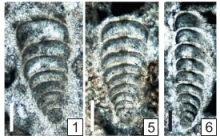
1397930 (urn:lsid:marinespecies.org:taxname:1397930)
accepted
Genus
Praerectoglandulina miklukhomaklayorum Vachard in Krainer, Vachard & Schaffhauser, 2019 † (type by original designation)
- Species Praerectoglandulina clava (Zolotova, 1980) †
- Species Praerectoglandulina conica (Miklukho-Maklay, 1954) †
- Species Praerectoglandulina costa (Lin, Li & Sun, 1990) †
- Species Praerectoglandulina deikovensis (Zolotova, 1980) †
- Species Praerectoglandulina geinitzinaeformis Vachard in Krainer, Vachard & Schaffhauser, 2019 †
- Species Praerectoglandulina imbecilla (Lin, Li & Sun, 1990) †
- Species Praerectoglandulina longa (Miklukho-Maklay, 1954) †
- Species Praerectoglandulina miklukhomaklayorum Vachard in Krainer, Vachard & Schaffhauser, 2019 †
- Species Praerectoglandulina ovalis (Baryshnikov, 1980) †
- Species Praerectoglandulina primitiva (Potievskaya, 1962) †
- Species Praerectoglandulina pusilla (Miklukho-Maklay, 1954) †
- Species Praerectoglandulina reliqua (Gerke, 1961) †
- Species Praerectoglandulina tschussovensis (Igonin, 1967) †
- Species Praerectoglandulina turae (Baryshnikov, 1982) †
- Species Praerectoglandulina wufengensis (Lin, Li & Sun, 1990) †
marine, brackish, fresh, terrestrial
fossil only
feminine
Krainer, K.; Vachard, D.; Schaffhauser, M. (2019). Early Permian (Yakhtashian; Artinskian - Early Kungurian) foraminifers and microproblematica from the Carnic Alps. <em>Abhandlungen der Geologischen Bundesanstalt.</em> 73:1-247., available online at https://opac.geologie.ac.at/wwwopacx/wwwopac.ashx?command=getcontent&server=images&value=Abh_0073.pdf
page(s): p. 119 [details] Available for editors
[request]
page(s): p. 119 [details] Available for editors
Description Description: Test free, uniserial, straight, medium to large-sized (Height = 300 – 900 μm), with 5 to 9 chambers....
Original description Diagnosis: Test small to submillimetric (Height = 300–900 μm). From 5 to 9 chambers. Sagittal axial section tapering....
Description Description: Test free, uniserial, straight, medium to large-sized (Height = 300 – 900 μm), with 5 to 9 chambers. Sagittal axial section tapering. Frontal axial section compressed. Transverse section rounded. Absence of ornamentation of the test and proloculus. Chambers strongly enveloping; sutures straight and not excavated or weakly excavated; attachment of chambers simple or compound. Sutures faint to absent. Chambers increase regularly in height. Septa increase weakly in thickness. Chambers curvated, non-enveloping, relatively low at the beginning but becoming relatively high in the last part. Wall proportionally rather thin. Aperture generally absent in thin section, or terminal, centered, radiate, elevated, often with an or simple, cylindrical, without peculiar characteristics.
Range and distribution: ?Early early Permian (Mamet & Pinard 1992); late early Permian (Cisuralian, middle Kungurian)- late Permian. FAD: probably Sakmarian; LAD: Changhsingian. Paleotethys and Neotethys.
(Vachard and Krainer (2022)). [details]
Range and distribution: ?Early early Permian (Mamet & Pinard 1992); late early Permian (Cisuralian, middle Kungurian)- late Permian. FAD: probably Sakmarian; LAD: Changhsingian. Paleotethys and Neotethys.
(Vachard and Krainer (2022)). [details]
Original description Diagnosis: Test small to submillimetric (Height = 300–900 μm). From 5 to 9 chambers. Sagittal axial section tapering....
Original description Diagnosis: Test small to submillimetric (Height = 300–900 μm). From 5 to 9 chambers. Sagittal axial section tapering. Frontal axial section compressed. Tranverse section
circular. Absence of ormentation of the test nor of the proloculus. Aperture generally absent in thin section or simple, cylindrical, without peculiar characteristics.
Sutures faint to absent. Chambers increase regularly in height. Septa increase weakly in thickness. Chambers curvated, non-enveloping, relatively low at the beginning but
becoming relatively high in the last part. Wall proportionally rather thin.
Comparison: It differs from Rectoglandulina by the shape of the chambers; from Frondinodosaria Sellier de Civrieux & Dessauvagie, 1965, Frondicularia sensu Sellier de Civreux & Dessauvagie, 1965, and Pseudolangella Sellier de Civrieux & Dessauvagie, 1965 by the shape of the test and the shape of the chambers.
Occurrence: FAD: probably Sakmarian–LAD: Changhsingian. Paleo- and Neotethys. Questionable in the early Permian of Sumatra and the Carnic Alps. Midian of Sumatra.
Midian–Lopingian of Taurus (Turkey), Italy, New Zealand. Nessen Formation of Alborz. “Middle” Wuchiapingian–late Changhsingian of Zagros, Himalaya. ?Midian of northwestern Turkey. Late Changhsingian of NW Caucasus, Transcaucasia, and South China. Late Midian of Zagros (Kuh-e Dena) and southern Turkey (Hazro). [details]
circular. Absence of ormentation of the test nor of the proloculus. Aperture generally absent in thin section or simple, cylindrical, without peculiar characteristics.
Sutures faint to absent. Chambers increase regularly in height. Septa increase weakly in thickness. Chambers curvated, non-enveloping, relatively low at the beginning but
becoming relatively high in the last part. Wall proportionally rather thin.
Comparison: It differs from Rectoglandulina by the shape of the chambers; from Frondinodosaria Sellier de Civrieux & Dessauvagie, 1965, Frondicularia sensu Sellier de Civreux & Dessauvagie, 1965, and Pseudolangella Sellier de Civrieux & Dessauvagie, 1965 by the shape of the test and the shape of the chambers.
Occurrence: FAD: probably Sakmarian–LAD: Changhsingian. Paleo- and Neotethys. Questionable in the early Permian of Sumatra and the Carnic Alps. Midian of Sumatra.
Midian–Lopingian of Taurus (Turkey), Italy, New Zealand. Nessen Formation of Alborz. “Middle” Wuchiapingian–late Changhsingian of Zagros, Himalaya. ?Midian of northwestern Turkey. Late Changhsingian of NW Caucasus, Transcaucasia, and South China. Late Midian of Zagros (Kuh-e Dena) and southern Turkey (Hazro). [details]
Hayward, B.W.; Le Coze, F.; Vachard, D.; Gross, O. (2025). World Foraminifera Database. Praerectoglandulina Vachard in Krainer, Vachard & Schaffhauser, 2019 †. Accessed at: https://www.marinespecies.org/foraminifera/aphia.php?p=taxdetails&id=1397930 on 2026-04-28
Date
action
by
original description
Krainer, K.; Vachard, D.; Schaffhauser, M. (2019). Early Permian (Yakhtashian; Artinskian - Early Kungurian) foraminifers and microproblematica from the Carnic Alps. <em>Abhandlungen der Geologischen Bundesanstalt.</em> 73:1-247., available online at https://opac.geologie.ac.at/wwwopacx/wwwopac.ashx?command=getcontent&server=images&value=Abh_0073.pdf
page(s): p. 119 [details] Available for editors
[request]
page(s): p. 119 [details] Available for editors
From editor or global species database
Description Description: Test free, uniserial, straight, medium to large-sized (Height = 300 – 900 μm), with 5 to 9 chambers. Sagittal axial section tapering. Frontal axial section compressed. Transverse section rounded. Absence of ornamentation of the test and proloculus. Chambers strongly enveloping; sutures straight and not excavated or weakly excavated; attachment of chambers simple or compound. Sutures faint to absent. Chambers increase regularly in height. Septa increase weakly in thickness. Chambers curvated, non-enveloping, relatively low at the beginning but becoming relatively high in the last part. Wall proportionally rather thin. Aperture generally absent in thin section, or terminal, centered, radiate, elevated, often with an or simple, cylindrical, without peculiar characteristics.Range and distribution: ?Early early Permian (Mamet & Pinard 1992); late early Permian (Cisuralian, middle Kungurian)- late Permian. FAD: probably Sakmarian; LAD: Changhsingian. Paleotethys and Neotethys.
(Vachard and Krainer (2022)). [details]
Original description Diagnosis: Test small to submillimetric (Height = 300–900 μm). From 5 to 9 chambers. Sagittal axial section tapering. Frontal axial section compressed. Tranverse section
circular. Absence of ormentation of the test nor of the proloculus. Aperture generally absent in thin section or simple, cylindrical, without peculiar characteristics.
Sutures faint to absent. Chambers increase regularly in height. Septa increase weakly in thickness. Chambers curvated, non-enveloping, relatively low at the beginning but
becoming relatively high in the last part. Wall proportionally rather thin.
Comparison: It differs from Rectoglandulina by the shape of the chambers; from Frondinodosaria Sellier de Civrieux & Dessauvagie, 1965, Frondicularia sensu Sellier de Civreux & Dessauvagie, 1965, and Pseudolangella Sellier de Civrieux & Dessauvagie, 1965 by the shape of the test and the shape of the chambers.
Occurrence: FAD: probably Sakmarian–LAD: Changhsingian. Paleo- and Neotethys. Questionable in the early Permian of Sumatra and the Carnic Alps. Midian of Sumatra.
Midian–Lopingian of Taurus (Turkey), Italy, New Zealand. Nessen Formation of Alborz. “Middle” Wuchiapingian–late Changhsingian of Zagros, Himalaya. ?Midian of northwestern Turkey. Late Changhsingian of NW Caucasus, Transcaucasia, and South China. Late Midian of Zagros (Kuh-e Dena) and southern Turkey (Hazro). [details]