| Introduction | | Search taxa | | Taxon tree | | Taxon match | | Checklist | | Literature | | Stats | | Photogallery | | OBIS Vocab | | Log in |
WoRMS taxon detailsHalecium Oken, 1815
 117103 (urn:lsid:marinespecies.org:taxname:117103)
accepted
Genus
Baleum Billard, 1929 · unaccepted
Endothecium Fraser, 1935 · unaccepted (preoccupied by Endothecium...)
preoccupied by Endothecium Koker,1924 [Anthozoa] Haloikema Bourne, 1890 · unaccepted (synonym)
Sagamihydra Hirohito, 1995 · unaccepted
Thoa Lamouroux, 1816 · unaccepted (synonym)
marine, fresh,
Oken, L. (1815-1816). Lehrbuch der Naturgeschichte. Dritter Theil: Zoologie. <em>Erste Abtheilung: Fleischlose Thiere,Leipzig: C.H. Reclam & Jena: A. Schmid, [book (3rd vol part one, of 3 vols, including plates atlas of T.1, 1813].</em> xxviii + 842 pp. + xviii, 40 pls. L [copepods 180-184, 357-359, 4 plates]., available online at https://doi.org/10.5962/bhl.title.166403 [details]

Schuchert, P. (2024). World Hydrozoa Database. Halecium Oken, 1815. Accessed through: World Register of Marine Species at: https://www.marinespecies.org/aphia.php?p=taxdetails&id=117103 on 2024-09-20
Date action by
original description
Oken, L. (1815-1816). Lehrbuch der Naturgeschichte. Dritter Theil: Zoologie. <em>Erste Abtheilung: Fleischlose Thiere,Leipzig: C.H. Reclam & Jena: A. Schmid, [book (3rd vol part one, of 3 vols, including plates atlas of T.1, 1813].</em> xxviii + 842 pp. + xviii, 40 pls. L [copepods 180-184, 357-359, 4 plates]., available online at https://doi.org/10.5962/bhl.title.166403 [details]
original description (of Thoa Lamouroux, 1816) Lamouroux, J. V. F. (1816). Histoire des polypiers coralligènes flexibles, vulgairement nommés zoophytes. <em>F. Poisson, Caen.</em> i-lxxxiv, 1-558, pls. I-XIX., available online at https://www.biodiversitylibrary.org/page/11606092 page(s): 210 [details] original description (of Baleum Billard, 1929) Billard, A., 1929. Note sur un genre nouveau et quelques espèces nouvelles d'Halecidae. Bull. Soc. zool. Fr. 54 : 305-307. page(s): 305 [details] original description (of Sagamihydra Hirohito, 1995) Hirohito, 1995. The hydroids of Sagami Bay. (Part 2. Thecata). Publs Biol. Lab., Imp. Household, Tokyo, 1995 : i-l, 1-244. page(s): 41 [details] original description (of Endothecium Fraser, 1935) Fraser, C.M. 1935a. Some Japanese hydroids, mostly new. Proceedings and transactions of the Royal Society of Canada (3)29 sect. V: 105-112, pl. 1-2. page(s): 107 [details] original description (of Haloikema Bourne, 1890) Bourne, G.C., 1890. Notes on the hydroids of Plymouth. J. mar. biol. Ass. U.K., n. ser. 1 4: 391-398., available online at https://www.biodiversitylibrary.org/page/11557347 page(s): 395 [details] taxonomy source Calder, D. R. (2017). Additions to the hydroids (Cnidaria, Hydrozoa) of the Bay of Fundy, northeastern North America, with a checklist of species reported from the region. <em>Zootaxa.</em> 4256(1): 1-86., available online at https://doi.org/10.11646/zootaxa.4256.1.1 page(s): Table 3.; note: characteristics of all accepted species [details] context source (Hexacorallia) Fautin, Daphne G. (2013). Hexacorallians of the World. (look up in IMIS) [details] basis of record van der Land, J.; Vervoort, W.; Cairns, S.D.; Schuchert, P. (2001). Hydrozoa, <B><I>in</I></B>: Costello, M.J. <i>et al.</i> (Ed.) (2001). <i>European register of marine species: a check-list of the marine species in Europe and a bibliography of guides to their identification. Collection Patrimoines Naturels,</i> 50: pp. 112-120 (look up in IMIS) [details] additional source Brunel, P., L. Bosse & G. Lamarche. (1998). Catalogue of the marine invertebrates of the estuary and Gulf of St. Lawrence. <em>Canadian Special Publication of Fisheries and Aquatic Sciences, 126.</em> 405 pp. (look up in IMIS) [details] Available for editors  [request] [request] additional source NODC. (1997). NODC Taxonomic codes. [details] additional source Integrated Taxonomic Information System (ITIS). , available online at http://www.itis.gov [details] additional source Hansson, H. (2004). North East Atlantic Taxa (NEAT): Nematoda. Internet pdf Ed. Aug 1998., available online at http://www.tmbl.gu.se/libdb/taxon/taxa.html [details] Available for editors [request] additional source Liu, J.Y. [Ruiyu] (ed.). (2008). Checklist of marine biota of China seas. <em>China Science Press.</em> 1267 pp. (look up in IMIS) [details] Available for editors [request] additional source Cairns, S.D., L. Gershwin, F.J. Brook, P. Pugh, E.W. Dawson, O.V.; Ocaña, W. Vervoort, G. Williams, J.E. Watson, D.M. Opresko, P. Schuchert, P.M. Hine, D.P. Gordon, H.I. Campbell, A.J. Wright, J.A.Sánchez & D.G. Fautin. (2009). Phylum Cnidaria: corals, medusae, hydroids, myxozoans. <em>in: Gordon, D.P. (Ed.) (2009). New Zealand inventory of biodiversity: 1. Kingdom Animalia: Radiata, Lophotrochozoa, Deuterostomia.</em> pp. 59-101., available online at https://repository.si.edu/handle/10088/8431 [details] Available for editors [request] status source Opinion 1220. (1982). Halecium Oken, 1815, (Coelenterata, Hydroida): ruled to be an available name & conserved. <em>Bulletin of Zoological Nomenclature.</em> 39(3): 172-174., available online at https://www.biodiversitylibrary.org/page/12228085 page(s): 172 [details]  Present Inaccurate Introduced: alien Containing type locality Present Inaccurate Introduced: alien Containing type locality
From editor or global species database
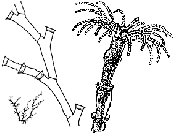
Diagnosis Colony usually erect, monosiphonic or polysiphonic, branched or unbranched, arising from a creeping hydrorhiza, stem and branches divided in internodes bearing apohyses near distal end; hydrothecae alternate, sessile or pedicellate, borne on apophyses when not pedicellate, shallow; rim commonly everted and regenerated; a ring of large desmocytes and a basal diaphragm; hydranth not retractable into hydrotheca, often with an annular bugle half way up the gastric column; intertentacular web present or not; nematotheca and nematophores absent; gonophores as fixed sporosacs in gonothecae sometimes with acrocyst, gonothecae either solitary or aggregated to form a glomulus, usually sexually dimorphic, sometimes with gonophoral polyps or arising from within hydrothecae; typically sexually dimorphic. [details]
|

