Foraminifera taxon details
Astrorhiza Sandahl, 1858
112299 (urn:lsid:marinespecies.org:taxname:112299)
accepted
Genus
Astrorhiza limicola Sandahl, 1858 (type by original designation)
Arastrorhizum Rhumbler, 1913 · unaccepted (Opinion of Loeblich & Tappan, 1987)
Arenistella Fischer, 1875 · unaccepted (Subjective junior synonym Opinion...)
Subjective junior synonym Opinion of Loeblich & Tappan, 1987
Astrodiscus Schulze, 1875 · unaccepted (Junior homonym of Astrodiscus...)
Junior homonym of Astrodiscus Ludwig, 1866
Haeckelina Bessels, 1875 · unaccepted (Opinion of Loeblich & Tappan, 1987)
Megamoebomyxa Nyholm, 1950 · unaccepted
- Species Astrorhiza agglutinata Cushman, 1921
- Species Astrorhiza arenacea (Schulze, 1875)
- Species Astrorhiza arenaria Carpenter in Norman, 1877
- Species Astrorhiza bakonycsernyensis Ozsvárt, 2007 †
- Species Astrorhiza compressiuscula Chapman, 1924
- Species Astrorhiza constans Bell, 1996 †
- Species Astrorhiza cretacea Franke, 1928 †
- Species Astrorhiza erratica Eisenack, 1954 †
- Species Astrorhiza furcata Goës, 1896
- Species Astrorhiza gigantea (Bessels, 1875)
- Species Astrorhiza granulosa (Brady, 1879)
- Species Astrorhiza limicola Sandahl, 1858
- Species Astrorhiza polygona Earland, 1934 †
- Species Astrorhiza porosa Ukharskaya, 1975 †
- Species Astrorhiza sinus Bell, 1996 †
- Species Astrorhiza tenuis Goës, 1896
- Species Astrorhiza triquetra Bell, 1996 †
- Species Astrorhiza vermiculata Le Calvez, 1935
- Species Astrorhiza virgilensis Ireland, 1956 †
- Subgenus Astrorhiza (Astrorhizoides) Shchedrina, 1969 accepted as Astrorhizoides Shchedrina, 1969
- Species Astrorhiza angulosa Brady, 1881 accepted as Astrorhiza granulosa (Brady, 1879) (unaccepted > junior subjective synonym, Subjective junior synonym Opinion of Jones (1994), Gooday and Smart (2000))
- Species Astrorhiza arctica Shchedrina, 1964 accepted as Astrorhiza limicola Sandahl, 1858
- Species Astrorhiza arenifera Shchedrina, 1946 accepted as Astrorhiza limicola Sandahl, 1858
- Species Astrorhiza catenata Norman, 1877 accepted as Aschemonella catenata (Norman, 1877) (superseded original combination)
- Species Astrorhiza cornuta Brady, 1879 accepted as Astrorhizoides cornutus (Brady, 1879)
- Species Astrorhiza crassatina Brady, 1881 accepted as Bathysiphon crassatina (Brady, 1881) accepted as Bathysiphon crassatinus (Brady, 1881) (Genus transfer)
- Species Astrorhiza gigantea Saidova, 1970 accepted as Astrorhizinulla gigantea (Saidova, 1970) (unaccepted > superseded combination, Opinion of Saidova (1975))
- Species Astrorhiza hancocki Cushman & McCulloch, 1939 accepted as Astrorhizoides hancocki (Cushman & McCulloch, 1939) (Opinion of Zheng & Fu, 2008)
- Species Astrorhiza sabulifera Shchedrina, 1946 accepted as Astrorhiza limicola Sandahl, 1858
- Species Astrorhiza salebrosa Saidova, 1970 accepted as Astrorhizinulla salebrosa (Saidova, 1970) (unaccepted > superseded combination, Opinion of Saidova (1975))
- Species Astrorhiza triangularis Earland, 1933 accepted as Astrammina triangularis (Earland, 1933) accepted as Rhabdammina triangularis (Earland, 1933) (Genus transfer)
- Species Astrorhiza vermiformis Goës, 1896 accepted as Argillotuba vermiformis (Goës, 1896)
marine, brackish, fresh, terrestrial
recent + fossil
feminine
Sandahl, O., 1858, Två nya former af Rhizopoder, Öfversigt af K. Vetenskaps-Akademien Förhandlingar Stockholm (1857) 14(8):299-303. , available online at https://biodiversitylibrary.org/page/43967143
page(s): p. 301 [details]
page(s): p. 301 [details]
LSID urn:lsid:algaebase.org:taxname:104379
LSID urn:lsid:algaebase.org:taxname:104379 [details]
Hayward, B.W.; Le Coze, F.; Vachard, D.; Gross, O. (2024). World Foraminifera Database. Astrorhiza Sandahl, 1858. Accessed at: https://marinespecies.org/foraminifera/aphia.php?p=taxdetails&id=112299 on 2024-09-20
Date
action
by
2006-09-06 06:55:51Z
changed
Martinez, Olga
original description
Sandahl, O., 1858, Två nya former af Rhizopoder, Öfversigt af K. Vetenskaps-Akademien Förhandlingar Stockholm (1857) 14(8):299-303. , available online at https://biodiversitylibrary.org/page/43967143
page(s): p. 301 [details]
original description (of Arenistella Fischer, 1875) Folin L. de & Périer L. (1867-1887). <i>Les fonds de la mer</i>. Paris: Savy. 4 volumes. Dates after Rehder (1946), <i>Proceedings of the Malacological Society of London</i>, 27: 74-75. Vol. 1: 1-48 (1867), 49-112 (1868), 113-176 (1869), 177-256 (1870), 257-272 (1872), pls 1-32; Vol. 2: 1-64 (1872), 65-112 (1873), 113-124 (1874), 125-160 (1875), 161-208 (1873), 209-304 (1874), 305-360 (1875), 361-365 (1876), pls 1-11; Vol. 3: 1-96 (1876), 97-208 (1877), 209-304 (1879), 305-337 (1880), pls 1-9; Vol. 4: 1-32 (1881), 33-148 (1881-1884), 149-192 (1884-1887), 192-240 (1887), pls 1-15. Dates for plates not exactly known. , available online at http://www.biodiversitylibrary.org/item/108784
page(s): vol. 2 part 1 chap. 8 p. 52 according to Loeblich and Tappan (1987) [details]
original description (of Astrodiscus Schulze, 1875) Schulze, RE., 1875, Zoologische Ergebnisse der Nord-seefahrt, vom 21 Juli bis 9 September, 1872. I, Rhizopoden. II, Jahresberichte Kommission zur Untersuchung der Deutschen Meer in Kiel für die Jahr 1872, 1873, pp. 99-114. , available online at https://www.zobodat.at/pdf/MON-ALLGEMEIN_0299_0001-0447.pdf
page(s): p. 113 [details] Available for editors [request]
original description (of Arastrorhizum Rhumbler, 1913) Rhumbler, L. (1913). Die Foraminiferen (Talamophoren) der Plankton-Expedition. Zugleich Entwurf eines natürlichen Systems der Foraminiferen auf Grund selektionistischer und mechanisch-physiologischer Faktoren. Zweiter Teil : Systematik. <em>Ergebnisse der Plankton-Expedition der Humboldt-Stiftung.</em> Bd.3 L.c.: 332-476., available online at https://www.biodiversitylibrary.org/page/2124278 [details]
original description (of Haeckelina Bessels, 1875) Bessels, E. (1875). Haeckelina gigantea. Ein Protist aus der Gruppe der Monothalamien. <em>Jenaische Zeitschrift für Naturwissenschaft.</em> 9: 265-271., available online at https://books.google.pt/books/about/Jenaische_Zeitschrift_für_Naturwissensc.html?id=kWvxAAAAMAAJ
page(s): p. 265 [details]
original description (of Megamoebomyxa Nyholm, 1950) Nyholm, K.-G. (1950). A marine nude rhizopod type Megamoebomyxa argillobia. <em>Zoologiska Bidrag från Uppsala.</em> 29: 93-102, 1+2 pls. [details] Available for editors [request]
basis of record Gross, O. (2001). Foraminifera, <B><I>in</I></B>: Costello, M.J. <i>et al.</i> (Ed.) (2001). <i>European register of marine species: a check-list of the marine species in Europe and a bibliography of guides to their identification. Collection Patrimoines Naturels,</i> 50: pp. 60-75 (look up in IMIS) [details]
additional source Neave, Sheffield Airey. (1939-1996). Nomenclator Zoologicus vol. 1-10 Online. <em>[Online Nomenclator Zoologicus at Checklistbank. Ubio link has gone].</em> , available online at https://www.checklistbank.org/dataset/126539/about [details]
page(s): p. 301 [details]
original description (of Arenistella Fischer, 1875) Folin L. de & Périer L. (1867-1887). <i>Les fonds de la mer</i>. Paris: Savy. 4 volumes. Dates after Rehder (1946), <i>Proceedings of the Malacological Society of London</i>, 27: 74-75. Vol. 1: 1-48 (1867), 49-112 (1868), 113-176 (1869), 177-256 (1870), 257-272 (1872), pls 1-32; Vol. 2: 1-64 (1872), 65-112 (1873), 113-124 (1874), 125-160 (1875), 161-208 (1873), 209-304 (1874), 305-360 (1875), 361-365 (1876), pls 1-11; Vol. 3: 1-96 (1876), 97-208 (1877), 209-304 (1879), 305-337 (1880), pls 1-9; Vol. 4: 1-32 (1881), 33-148 (1881-1884), 149-192 (1884-1887), 192-240 (1887), pls 1-15. Dates for plates not exactly known. , available online at http://www.biodiversitylibrary.org/item/108784
page(s): vol. 2 part 1 chap. 8 p. 52 according to Loeblich and Tappan (1987) [details]
original description (of Astrodiscus Schulze, 1875) Schulze, RE., 1875, Zoologische Ergebnisse der Nord-seefahrt, vom 21 Juli bis 9 September, 1872. I, Rhizopoden. II, Jahresberichte Kommission zur Untersuchung der Deutschen Meer in Kiel für die Jahr 1872, 1873, pp. 99-114. , available online at https://www.zobodat.at/pdf/MON-ALLGEMEIN_0299_0001-0447.pdf
page(s): p. 113 [details] Available for editors
[request] original description (of Arastrorhizum Rhumbler, 1913) Rhumbler, L. (1913). Die Foraminiferen (Talamophoren) der Plankton-Expedition. Zugleich Entwurf eines natürlichen Systems der Foraminiferen auf Grund selektionistischer und mechanisch-physiologischer Faktoren. Zweiter Teil : Systematik. <em>Ergebnisse der Plankton-Expedition der Humboldt-Stiftung.</em> Bd.3 L.c.: 332-476., available online at https://www.biodiversitylibrary.org/page/2124278 [details]
original description (of Haeckelina Bessels, 1875) Bessels, E. (1875). Haeckelina gigantea. Ein Protist aus der Gruppe der Monothalamien. <em>Jenaische Zeitschrift für Naturwissenschaft.</em> 9: 265-271., available online at https://books.google.pt/books/about/Jenaische_Zeitschrift_für_Naturwissensc.html?id=kWvxAAAAMAAJ
page(s): p. 265 [details]
original description (of Megamoebomyxa Nyholm, 1950) Nyholm, K.-G. (1950). A marine nude rhizopod type Megamoebomyxa argillobia. <em>Zoologiska Bidrag från Uppsala.</em> 29: 93-102, 1+2 pls. [details] Available for editors
[request] basis of record Gross, O. (2001). Foraminifera, <B><I>in</I></B>: Costello, M.J. <i>et al.</i> (Ed.) (2001). <i>European register of marine species: a check-list of the marine species in Europe and a bibliography of guides to their identification. Collection Patrimoines Naturels,</i> 50: pp. 60-75 (look up in IMIS) [details]
additional source Neave, Sheffield Airey. (1939-1996). Nomenclator Zoologicus vol. 1-10 Online. <em>[Online Nomenclator Zoologicus at Checklistbank. Ubio link has gone].</em> , available online at https://www.checklistbank.org/dataset/126539/about [details]
 Present Inaccurate Introduced: alien Containing type locality
From editor or global species database
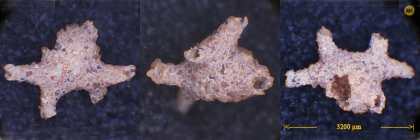
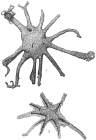
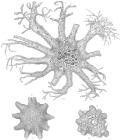
Diagnosis Test free, large, up to 15 mm in diameter, lenticular, with several stolon-like arms (4 to 15) radiating in the plane of the disc and tapering and branching terminally; wall consists of many layers of agglutinated material, ranging from fine mud to relatively coarse sandy particles, sponge spicules, or smaller foraminifers, inner organic layer reported in some species; apertures at the ends of the radiating arms. M. Ordovician to Holocene; cosmopolitan. (Loeblich & Tappan, 1987, Foraminiferal Genera and Their Classification) [details]From other sources
LSID urn:lsid:algaebase.org:taxname:104379 [details]