WoRMS taxon details
Plumulariidae McCrady, 1859
1613 (urn:lsid:marinespecies.org:taxname:1613)
accepted
Family
Plumularidae McCrady, 1859 · unaccepted (incorrect name formation)
- Genus Antomma Stechow, 1919
- Genus Callicarpa Fewkes, 1881
- Genus Cladacanthella Calder, 1997
- Genus Dentitheca Stechow, 1920
- Genus Hippurella Allman, 1877
- Genus Monotheca Nutting, 1900
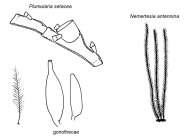
- Genus Nemertesia Lamouroux, 1812
- Genus Plumularia Lamarck, 1816
- Genus Pseudoplumaria Ramil & Vervoort, 1992
- Genus Schizoplumularia Ansín Agís, Ramil & Calder, 2016
- Genus Sciurella Allman, 1883
- Genus Sibogella Billard, 1911
- Genus Acanthella Allman, 1883 accepted as Cladacanthella Calder, 1997 (invalid junior homonym of Acanthella Schmidt, 1862 [Porifera], )
- Genus Antennopsis Allman, 1877 accepted as Nemertesia Lamouroux, 1812 (unaccepted > junior subjective synonym, synonym)
- Genus Antennularia Lamarck, 1816 accepted as Nemertesia Lamouroux, 1812
- Genus Lowenia Meneghini, 1843 accepted as Plumularia Lamarck, 1816 (synonym)
- Genus Monothecella Stechow, 1923 accepted as Plumularia Lamarck, 1816 (synonym)
- Genus Nemertella Stechow, 1923 accepted as Nemertesia Lamouroux, 1812 (unaccepted > junior subjective synonym)
- Genus Polynemertesia Broch, 1918 accepted as Polyplumaria Sars, 1874
- Genus Polyplumularia Sars, 1874 accepted as Polyplumaria Sars, 1874 (unaccepted > misspelling - incorrect subsequent spelling)
- Genus Sphaerocystis Fraser, 1943 accepted as Dentitheca Stechow, 1920
- Genus Stechowia Nutting, 1927 accepted as Sibogella Billard, 1911
marine, fresh, terrestrial
Not documented
Schuchert, P. (2024). World Hydrozoa Database. Plumulariidae McCrady, 1859. Accessed through: World Register of Marine Species at: https://www.marinespecies.org/aphia.php?p=taxdetails&id=1613 on 2024-09-20
Date
action
by
2004-12-21 15:54:05Z
created
db_admin
 The webpage text is licensed under a Creative Commons Attribution 4.0 License
original description
(of Plumularidae McCrady, 1859) McCrady, J. 1859. Gymnopthalmata of Charleston Harbor. Proceedings of the Elliott Society of Natural History 1: 103-221, pls 8-12. , available online at https://www.biodiversitylibrary.org/page/42536587
page(s): 198 [details]
context source (Hexacorallia) Fautin, Daphne G. (2013). Hexacorallians of the World. (look up in IMIS) [details]
basis of record Calder D.R. (1997). Shallow-water hydroids of Bermuda: superfamily Plumularioidea. <em>Royal Ontario Museum Life Sciences Contributions.</em> 161: 1-86.
page(s): 8 [details]
page(s): 198 [details]
context source (Hexacorallia) Fautin, Daphne G. (2013). Hexacorallians of the World. (look up in IMIS) [details]
basis of record Calder D.R. (1997). Shallow-water hydroids of Bermuda: superfamily Plumularioidea. <em>Royal Ontario Museum Life Sciences Contributions.</em> 161: 1-86.
page(s): 8 [details]
 Present Inaccurate Introduced: alien Containing type locality
From editor or global species database
Diagnosis Colonies erect, monosiphonic or polysiphonic, arising from creeping, rootlike, or disc-shaped hydrorhiza; hydrocauli branched or unbranched, hydrocladia alternate, opposite or in verticils, arising in polysiphonic hydrocauli from a single axial tube; hydrothecae typically small, uniseriate, usually at least partially adnate, occurring only on hydrocladia, with or without marginal cusps; nematophores with well developed nematothecae, not as naked sarcostyles; all nematothecae (axillar, cauline or hydrothecal) usually two-chambered (bithalamic) and movable, a minimum of three nematothecae adjacent to hydrothecae, one mesial inferior and a pair of lateral ones; gonophores as fixed sporosacs, exceptionally as swimming gonophores; gonothecae solitary, without nematothecae; with or without phylactocarps. [details]Spelling Spelling by Agassiz (1862: 358) was Plumularidae, Hincks (1868) introduced the correct spelling Plumulariidae. [details]

